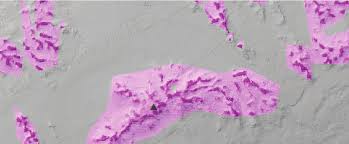
Benthic habitat research has focussed on species’s presences, densities and abundances. While this is useful, it only is part of the “picture”. To understand the function they serve as habitats and nutrient recyclers, it is important to understand the spatial variation in the size and biomass of species. This is why we developed the “biomass mapping” approach. A novel modelling approach which converts surface area measurements from images to biomass at a local and regional scale.
PUBLICATIONS
Greiffenhagen, L., Kutti, T., Maier, S. R., & De Clippele, L. H. (2024). Biomass mapping of fjordic cold-water coral reefs reveals distinct functional role of vertical wall habitat. Deep Sea Research Part I: Oceanographic Research Papers, 104350.
Maier, S.R., Brooke, S., De Clippele, L.H., de Froe, E., van der Kaaden, A.S., Kutti, T., Mienis, F. and van Oevelen, D., 2023. On the paradox of thriving cold‐water coral reefs in the food‐limited deep sea. Biological Reviews.
De Clippele LH, van der Kaaden A-S, Maier SR, de Froe E, Roberts JM (2021). Coral biomass and nutrient cycling at cold-water coral carbonate mounds. Frontiers in Marine Science 8:721062.
De Clippele LH, Rovelli L, Ramiro Sanchez B, Kazanidis G, Vad J, Turner S, Glud RN, Roberts JM (2020). Mapping cold water coral biomass an approach to derive ecosystem functions. Coral reefs 40(1):215-231.
 Laurence De Clippele's Research Group